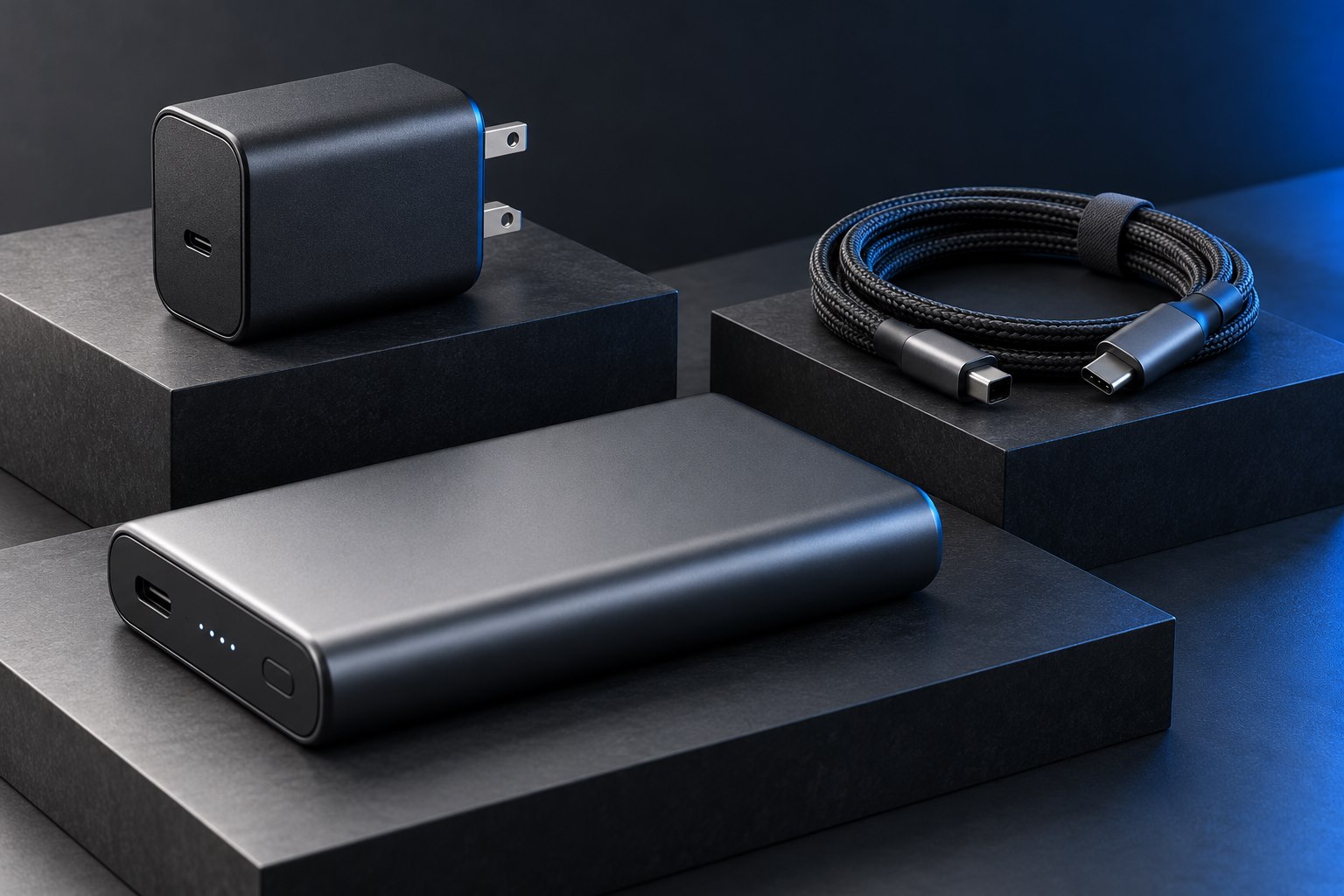
Distinguish charge capacity from stored energy
Milliamp-hours describe charge capacity at a stated voltage. Watt-hours describe energy. To compare batteries sensibly, the voltage context matters: watt-hours equal amp-hours multiplied by nominal voltage. A hypothetical bank rated at 10,000mAh and 3.7 volts represents 10 amp-hours times 3.7 volts, or 37 watt-hours of nominal stored energy. Use the manufacturer's printed watt-hour rating when it is available instead of assuming every bank uses the same nominal voltage.
Anker's explanation of power-bank labels distinguishes cell capacity, voltage, and watt-hours. The important shopping habit is to read the complete label rather than treating the largest mAh number as a direct count of phone charges. A laptop battery and a power bank can use different internal voltages, making a simple mAh comparison particularly misleading.
Separate stored energy from delivered energy
A power bank converts its internal battery energy to the output needed by the connected device. The receiving device then manages charging its own battery. Conversion, heat, electronics, and the device's activity consume some energy along the way. The nominal stored energy therefore cannot all become added energy in the phone or laptop battery. Wireless charging adds another transfer arrangement with its own losses.
Some manufacturers provide a rated output capacity under specified conditions in addition to cell capacity. Read the voltage and test conditions associated with that rating. Comparing two figures measured at different output voltages can be as misleading as comparing cell mAh values without context. A clear datasheet should make the distinction understandable rather than relying on an oversized headline number.
Use a range for a planning estimate
For an illustrative calculation, suppose a bank stores 37Wh and you assume that 75 percent ultimately becomes useful delivered energy for a particular setup. That assumption gives about 27.8Wh. If the receiving battery stores 15Wh, the arithmetic suggests less than two equivalent full charges before accounting for activity and other conditions. The 75 percent figure is only an example for planning, not a measured efficiency claim about a product.
The useful lesson is the structure of the calculation: stored energy, an explicit allowance for losses, and the receiving device's energy requirement. If the phone is navigating, using cellular data, and keeping its screen bright while charging, some delivered energy supports those tasks rather than filling the battery. A percentage indicator on the phone cannot separate those uses by itself.
Capacity is only one purchasing dimension
A larger bank can offer more energy but also more weight, volume, and recharge time. Output power determines whether it can charge a device at an adequate rate; capacity determines how much energy is available over time. A high-capacity bank with a modest output can be a poor laptop companion, while a smaller high-output bank may work well for short top-ups. Keep those dimensions separate.
| Label item | Question it answers |
|---|---|
| Watt-hours | How much nominal energy is stored? |
| Single-port output | Can it support the device's required charging mode? |
| Combined output | What happens when several devices are connected? |
| Input rating | How quickly can the bank itself recharge under supported conditions? |
| Weight and dimensions | Will the bank be carried often enough to be useful? |
Match the bank to a realistic day
Estimate the missing energy in your normal routine rather than demanding a theoretical maximum number of full charges. A commuter who needs one afternoon top-up may prefer a lighter bank that is actually carried. A field worker supporting a tablet and phone may need more reserve. Test the chosen bank with the actual devices before depending on it for an extended outing. Keep the printed capacity information readable for support and travel-policy checks, and consult current carrier rules separately when flying.
Sources & further detail
These references support the technical context. Examples and selection advice are editorial explanations; verify the documentation for your exact equipment and software.
A detail we should revisit? Send the guide URL and the relevant documentation to SmithKent5791@outlook.com.
Read the editorial policy