Look for the input specification
A power bank may charge a laptop at a high output while accepting a different maximum when refilling its own battery. Those are separate specifications. Find the line labeled input and identify which port supports it. A USB-C socket can be input, output, or both, depending on the product. Anker's model-specific recharge instructions demonstrate why a bank should be evaluated by its own manual rather than by the capabilities of a similar-looking model.
For daily use, recharge time can matter as much as capacity. A large bank that cannot refill during your available outlet time may begin each day partly depleted. Write down the actual window: an overnight stay, a lunch break, or a short stop between appointments. That makes it easier to choose a practical combination of stored energy and input capability.
Match the wall charger and cable
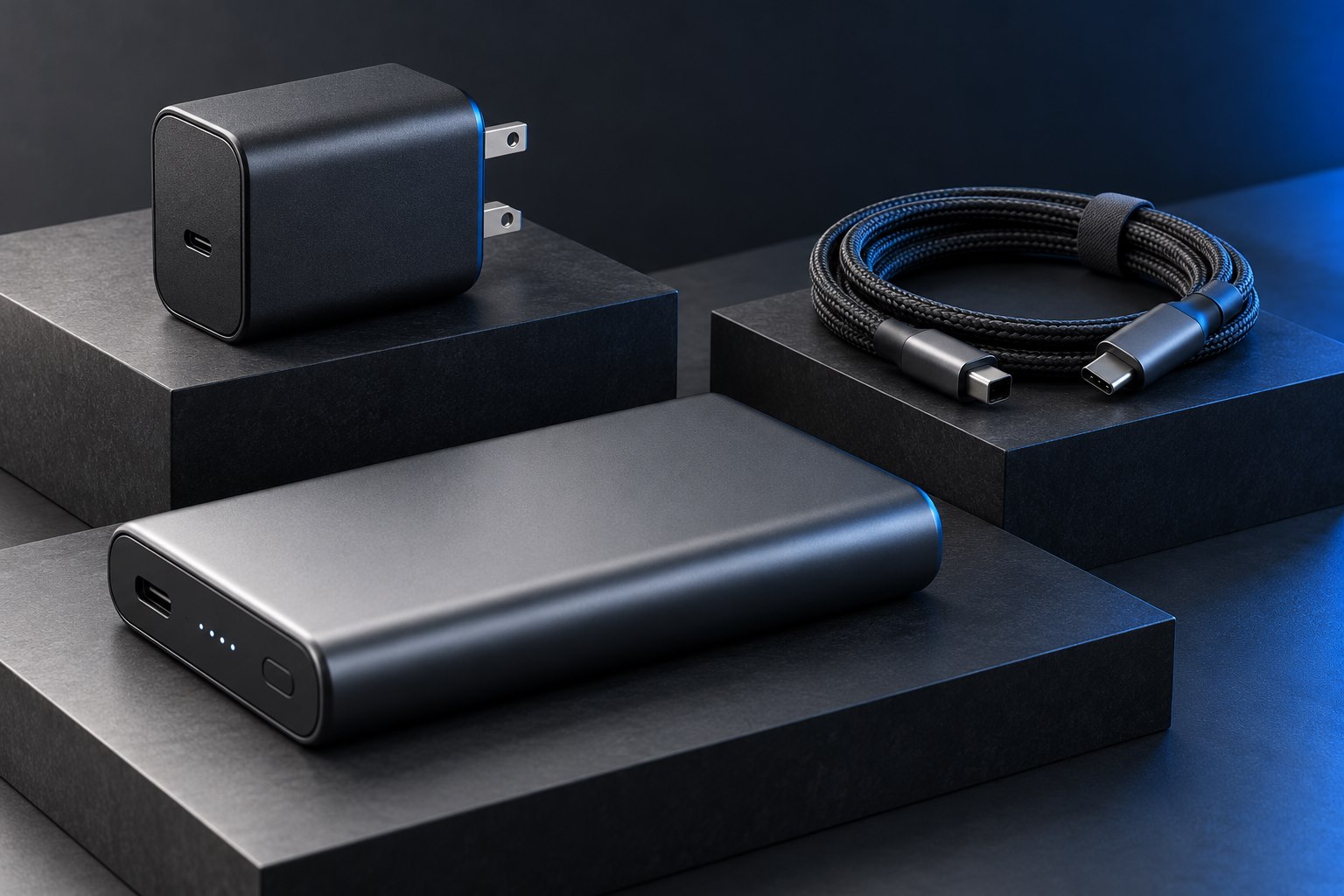
The bank can accept only a supported charging arrangement, and the wall charger must offer it. A high total wattage is not enough if the required output profile is absent or assigned to a different port. The cable must also support the intended power level. Use the bank manufacturer's recommended specifications, then check the actual charger-port combination rather than assuming any laptop adapter will achieve the maximum input.
If a multiport charger also powers a phone or laptop, its allocation may reduce what reaches the bank. A recharge estimate based on a dedicated high-output source will not necessarily apply to that shared arrangement. Test the combination you plan to carry. Sometimes a simpler dedicated charging session is more efficient than leaving several devices connected to an insufficient shared budget.
Use energy arithmetic as a lower-bound check
Dividing watt-hours by watts gives an idealized time if input power remained constant and all of it became stored energy. For example, a hypothetical 60Wh bank receiving 30W continuously would suggest two hours before accounting for losses and charging behavior. Real charging takes longer because power is not necessarily constant and the system manages the final part of the charge. Treat the calculation as a sanity check, not a promised completion time.
Manufacturer recharge claims should state the adapter and conditions used. Read those conditions before comparing two products. A claim for reaching 80 percent is different from a full recharge claim, and a bank with a large display may present a changing time estimate as conditions evolve. Neither a momentary input reading nor a short early interval predicts the entire session reliably.
Build the refill into the routine
Keep the appropriate charger and cable where the bank normally recharges, or include them in the travel kit if outlet access is unpredictable. Place the bank on a suitable uncovered surface and follow the manufacturer's operating instructions. Avoid leaving the charging arrangement buried in a closed bag. A convenient visible location also makes it less likely that the bank will be forgotten before departure.
After a normal day of use, time one ordinary recharge with your intended equipment. Note the starting level and whether other devices shared the charger. This gives a useful personal planning estimate without pretending to be a laboratory capacity test. If the bank consistently misses the available window, reconsider the charger, allocation, or bank size. More nominal capacity is not helpful when the refill routine cannot keep up.
Sources & further detail
These references support the technical context. Examples and selection advice are editorial explanations; verify the documentation for your exact equipment and software.
A detail we should revisit? Send the guide URL and the relevant documentation to SmithKent5791@outlook.com.
Read the editorial policy